Going into a new environment is something that I am accustom to, and this past year was no different with my big move to Maryville College. In this role, I have the honor of having full control over the hitters and making them the best they can be for the first time in my coaching career. I had been waiting for this moment for the past two years and I knew that I was ready. I had so much information that I wanted to instill upon them from day 1. I could’ve thrown all the information at them from the get go, but I knew this wasn’t the best course of action. I decided to focus on one key metric to implement in the fall and it was attack angle.
Attack angle is the angle of the bats path at impact. There is a good amount of information showing that having a positive attack angle is an important part of a good swing. Here is some data showing the attack angles from some notable Major leaguers.
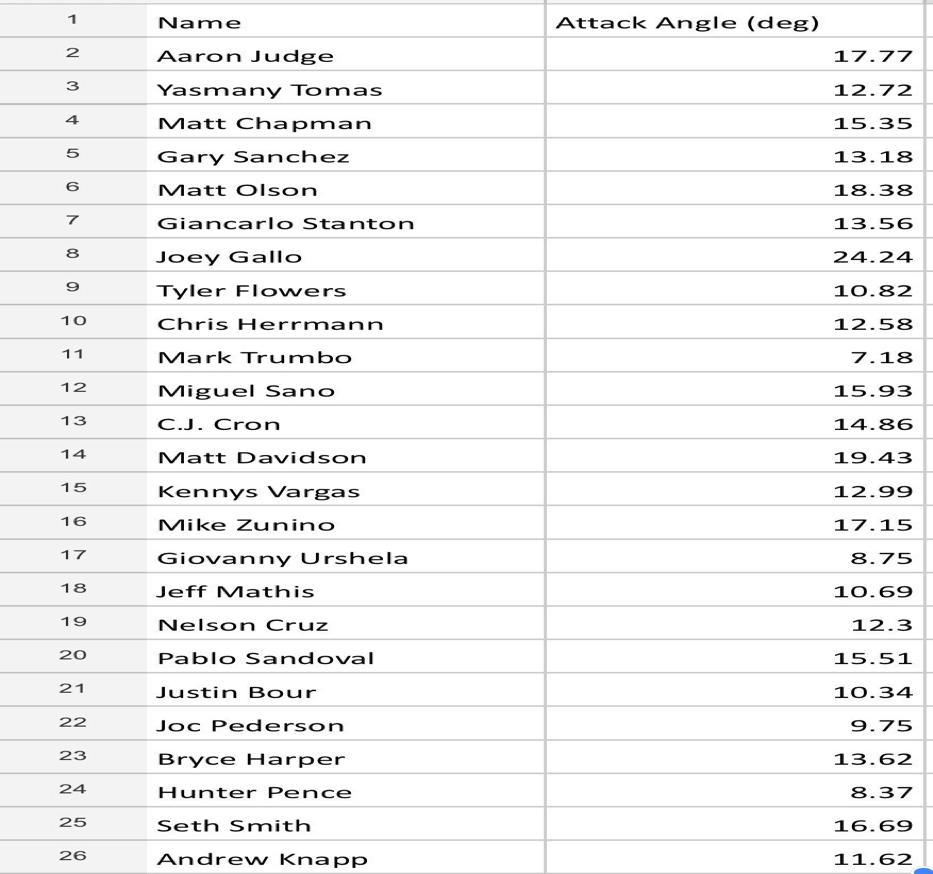
Credit : @JasonOchart from twitter
In 2017, there was not ONE Major Leaguer that had a negative attack angle. This metric was something I knew that I was going to have to tackle right away, in order to get the results I wanted. Many amateurs have a negative angle and this cuts down the amount of time that the bat is on plane with the baseball. Educating players on this metric is crucia,l because when someone tells you not to swing down, you overcorrect and swing straight up. I wanted them to know this was not the case. The sweet spot for attack angle will be different for players based on power. If a player does not have the power to get the ball over the outfielder’s heads, then he will have a lower attack angle than the player who can hit homeruns. This was the metric that I had the most confidence in, that I could make a positive change and would create the most impact. The players were ready for the change and were open to all the instruction to help them fix their poor attack angles. I made a chart to show how much of an impact improving attack angle can have on what matters, game statistics.
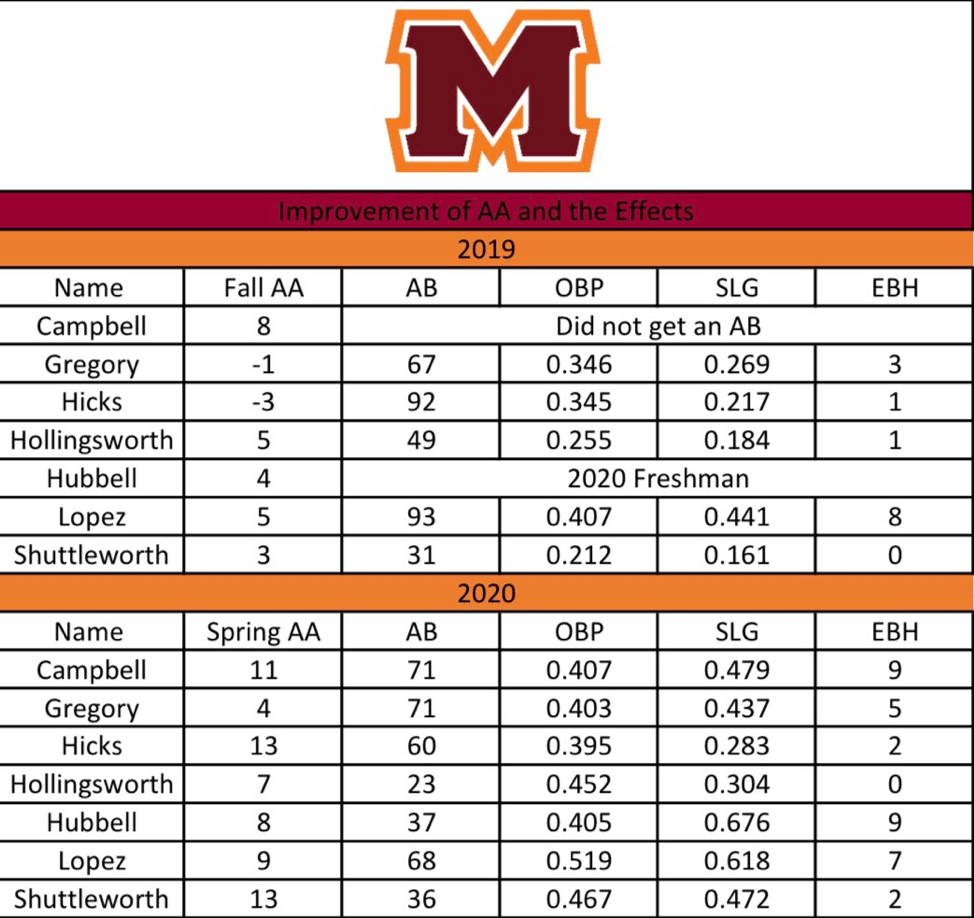
I am not saying that improving their attack angle was the only reason these players had an increase in performance, but I do believe that it was a part of their improvement. During quarantine, I have been reading up on all the other metrics and plan on using more to show improvements. I would suggest if you are in charge of a large group of hitters for the first time, to pick the metric that needs the most change and you feel would make the most impact. It just so happened that I felt strongly that we needed to change our attack angle and it worked out. Averages do not tell the entire story and this is the truth for all metrics. It is imperative that you look at the range of the data. I will give you two examples of data sets.
Player 1: Average AA- 8, Lowest AA- (-10), Highest AA-30 and Range- 40
Player 2 Average AA- 8, Lowest AA- -2, Highest AA- 20 and Range- 22
If you were to just look at these plays average attack angles, you would think they are the same. This is not the case and this data set shows that player 1 has a very inconsistent swing. In my short time working with this blast, I have found that timing has a crucial impact on what makes the range on attack angle data. It would be safe to say that player 2 has a more repeatable swing, which also means that his loading and timing mechanism could be better. The information I am giving you here is giving you a nice foundation of where to start. Finding the problem is very easy in today’s game because of all the technology that we have…but fixing the problem is still the hardest part. There are so many possible reasons for a poor metric number and it is our job as coaches to figure out what is going to help our players. I hope this gives you enough information to get started once we’re back on the field!
 CONNECTING THE DOTS BASEBALL
Leave a comment