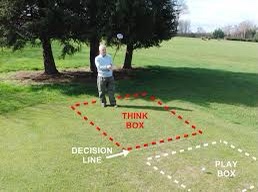
In one of the many Zoom calls I was a part of during quarantine, I heard something that struck me to a core. Bernie Holiday, Mental Skills Coach for the Pittsburgh Pirates, told us that that Anika Sorenstam credited her career success to the phrase, “Think Box, Play Box”. He went on to describe how before she addresses the ball, she would come up with a plan for the shot, “Think Box”. Then when she would address the ball, she would fully commit to just performing the swing, “Play Box”. She would use this with every shot she took, and the situation did not matter. The mental fortitude to fully commit to the mentality is quite impressive. I believe this shows why she was one of the greatest women’s golfers of all-time. Not only did she commit to a philosophy for the majority of her career, but she was able to eliminate all doubts before she went to strike the golf ball. Before I started this blog I decided to google this phrase to see what was out there on it. I stumbled upon Vision 54, a golf performance group. The name stands for shooting a score of 54, something that has never been done in a professional tournament. Here is a quick video explaining the thought process.
They believe that this can be done and have a performance model that includes “Think Box, Play Box” plus more. Baseball is often behind golf when it comes to technology and this group proves that we are behind in other areas as well. When it comes to instruction in baseball, think about where most of it happens. In pitching, the instruction happens while they are on the mound or in the bullpen. In hitting, the instruction happens while in the box or batting cage. When fielding/catching, the instructions happens while they are at their position. This is clearly not in line with the strategy of “Think Box, Play Box”. This leads players to think while they are trying to play the game. Ben Brewster had a great post that I think exemplifies what we are doing to our players when we give them multiple cues while playing the game.
To bring these phrases into practical use, there has to be aan understanding of where to use the boxes. I’ll start with think box- because I believe this is where the “greats” separate themselves. In golf, you have to be able to execute a plan of exactly how you’re going to strike a golf ball. In baseball, there are many more factors that make it easier to just go up there swinging and think internally rather than externally. One of the best examples of this was in the movie Happy Gilmore- when he shifts his mentality from internal thought in the think box to external thought. Here’s a short video of this scene:
Chubbs does two things in this video that gets Happy’s think box to shift from internal to external thought. First thing Chubbs says, “Look at the green, make contact with the ball and there’s no goalie to block it.” What did he do here? He made him realize how easy this task is compared to what he is used to doing, which is playing hockey. Happy was making the task much harder than it really was because of the crowd behind him. The second thing Chubbs did was do something embarrassing. This completely took Happy out of that pressure filled moment that he was in and got him to relax. The rest of the movie is about him escaping his negative thoughts and moving to his happy place. I don’t know if many people make this connection because this movie is a comedy…but it actually shows a ton of useful tools on how to handle the “think box”.
Now obviously golf and baseball are more complicated than Happy Gilmore depicts in this scene. There is talk about yardage, shot type and what club to use in golf. In baseball, we often talk about who is on the mound and what the situation is. This talk happens in the dugout and when we are on deck, we are there to warm up and get our timing down. This process, when actually done, is usually on point. The problems begin to arise when we walk to the plate. This is when we’re supposed to leave “Think Box” behind and transition into “Play Box”.
Play Box is what I believe is the real game changer for anyone who is reading this blog. We need to make a conscious effort as coaches to keep the playing field the “Play Box”. Using physical barriers is a great first step when being able to separate the two boxes. Here are some suggestions of how to solidify the “Play Box”.
- When hitting in the cages, do all the instruction outside of it.
- When taking batting practice on the field, do all of the instruction outside of the cage.
- During Games, only talk about confidence and plan of attack against who’s pitching
- During bullpens, have them come off the mound and address the mound when getting back into the bullpen.
Timing of information is just as important as the information itself. The next step is having the athletes apply this information for themselves. When they are applying the information, it needs to be done in the same manner that it was given to them. Giving them tangible barriers would be a good idea. This means the cage, the batter’s box, and the pitcher’s mound. Breath is a good clearing mechanism before entering the “play box”, this will be covered in a future blog. I really believe this can be game changing information and I can’t wait to implement it with the Scots! If anyone wants to discuss this topic further, please reach out!
 CONNECTING THE DOTS BASEBALL
Leave a comment