
It was the middle of summer and I saw a tweet from Desi Druschel recommending a podcast with Daniel Coyle, the author of the Talent/Culture Code. It was the Mission Critical Team Institute team cast. He said to start the podcast from the first episode and I’m sure glad that I did. It is my favorite podcast out right now. I have many notes from these guys, but there is one episode that really hit me as actionable information. That was episode 11 “After Action Reviews” with Coleman Ruiz and Dr. Preston Cline. I knew that this was a process that I wanted to immediately implement during the season. Since listening to this episode, we have now had 3 AAR (after action review) meetings for our hitters at Maryville College. Dr. Preston Cline wrote a paper that I will have linked at the end of the blog. I’ll go over the preparation, engagement and closure of the 3 meetings that we have had.
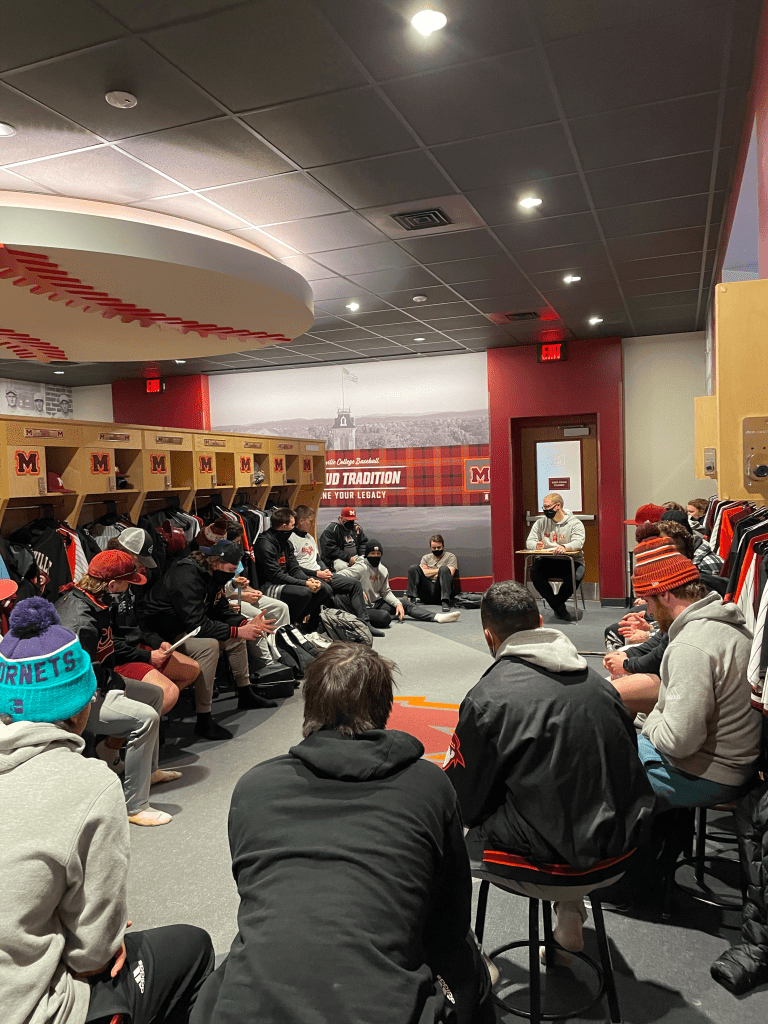
Dr. Coleman Ruiz explains how to prepare the environment. Thankfully at Maryville College, we have the perfect setting to accommodate an AAR, and that’s our locker room. It was opened in January 2019 and still feels and looks brand new. Our meetings have been after practice on Tuesdays. Here’s the list Coleman Ruiz lays out:
· Physiology– They get into fresh clothes after practice and hydrate up with water.
· Timing– Our meetings have been after practice on Tuesdays, typically one of the lighter practice days of the week
· Room setup + security– We all pull up our locker chairs and sit in a circle, no rank established. We also use a baseball to make sure no one talks over each other.
Phase 1 of the AAR is the opening question. I set the stage with asking questions as to what we thought we did well and what we could improve on. I try to use as little words as possible- to make sure that I do not take control of the discussion. I let the players take control if they want to talk about the positives or negatives first. We then move onto phase 2. My job of this portion is to make sure we stay on the delta, the actional items from the previous week. The players often drift onto emotional issues. This is fine, but I try to lead the conversation back to what we can do to fix these problems. Once we have identified the strengths and weaknesses of the previous week, I ask what we can do at practice to try and combat these issues that we already spoke about. This is my favorite portion of the discussion. I try to give the players ownership of their training so that there is greater buy-in. This leads right into phase 3 of the discussion. We agree on the practice plan for the week. I also try to end the discussion with, “let’s get to work”.
Closure has been a very important portion for us. Miscommunication is one of the main reasons for a faulty practice plan. If we agree on something, we need to work on then it’s never addressed at practice, we’ll have a problem. Even though I have no rank in the discussion, it is my job to see who is confused by some of the conversation going on. After the meeting, I will approach these individuals and have personal discussions to see if there was anything I could clear up for them. These side bars will be specifically about the individual and nothing on team matters. If the conversation goes towards what we need to do as a team, I will tell the individual to bring this up to the team or bring it up in the next AAR if it’s not vital information.
The last thing I would like to add to this review of our AAR’s is that we have done 3 in person sessions and 1 via zoom. The most recent one was done via zoom because of covid-19 protocols. This was by far our most difficult review. It shows how important physical cues can be when discussing issues amongst a team setting. This is something that we all understand with what has transpired over the past year. This exercise shows exact reasons why though. I have less than half the number of notes from the zoom session as I do from the 3 in-person sessions. It also shows the importance of having a physical object, the baseball, present to control the conversation. I have been on many zoom calls that I say nothing because I do not want to talk over someone else. AAR’s will be a part of my coaching repertoire for years to come and I’m excited to see how much I can learn from my players!
 CONNECTING THE DOTS BASEBALL
Leave a comment