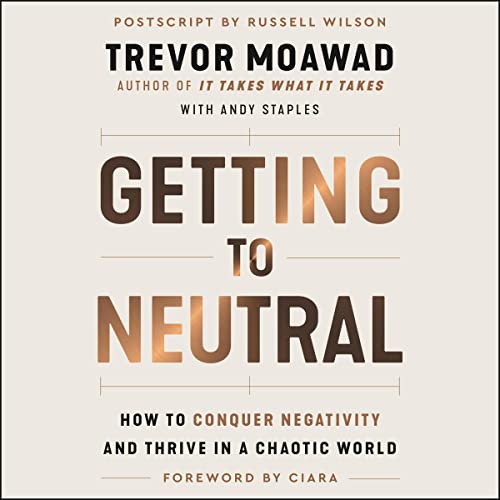
A book was just released from the late Trevor Moawad called, “Getting to Neutral.” This book expands on his methods that he explained in his first book, “It Takes What It Takes.” Trevor’s story starts with how he was raised. His father, Bob Moawad, was a motivational speaker and talked about the importance of positive thinking. This led Trevor down the path of his professional career, and he started to notice that he did not fully agree with what his father taught to thousands, during his life. Trevor found the true secret sauce was to take in everything as it comes, and do what needs to be done in the moment to succeed. The titles of both books written by Trevor clearly explain his philosophy. I have had some personal moments in my life that neutral thinking changed my life and I wanted to share that with you. This blog is also a public thank you to Trevor…for defining this thought process that is now one of the core values of my life.
The first time in my life that I can remember using the process of neutral thinking was near the end of my freshman year of college. I came in on a big scholarship, and due to some unfortunate circumstances, everyone knew about it and exactly how much it was. Did I have the talent of a big time scholarship division 1 baseball player? No. I knew that I needed to do something about it. I was brought in for power I had at the plate and that had disappeared. Looking at the situation neutrally, there really was only one thing that had changed: my weight. I was 215 pounds and my college coach told me I should lose some weight. I came into the fall of my freshman year at 195. Lowest weight of my life since I was in middle school. Since this was the only thing that had changed, I knew that I needed to gain it back. How do you gain weight? One day at a time. I went home and when you’re raised by your grandparents…this is a very easy process. I would wake up, eat, go to the baseball field, workout, eat, play video games and eat. What a life that is, huh? This is an example where the habits of living neutrally were pretty easy to follow.
The next example is to show you the good and bad of neutral thinking. I truly believe that everything in life can be good and bad at the same time. When we talk about something good- there can be an angle of where it is bad at the same time for someone else. During my junior year of college, I was told that my mother was diagnosed with ovarian cancer. So my instant reaction was to ask what the next steps would be. When I was told what the plan was, I moved on and knew things were under control. Think about that for a second. I was able to move on that quickly from the news that my mother had been diagnosed with cancer? What is wrong with me? Why did I not lose my mind? Why did I not worry about her constantly? The reason was because I was thinking neutrally. I thought in my mind that there was nothing I could do personally about the problem, and the people who could do something about it were going to take care of it. I just went on with my life. When you think neutrally you don’t think about the consequences of what bad could happen on the daily. So when the bad news does come…it hits you like a damn train. When my mom passed away from cancer, it was unbearable for a short period of time. It was only a week after what had happened and I got the call from my summer ball coach Dale Ijames that I should come back and play. I thought about it and realized that he was right. Would my Mom want me to sit in depression for the rest of my life? No. So I went back and played baseball and it was the best choice I ever made in my life- because I fulfilled a dream of playing in the Cape Cod Baseball League that summer.
I want to dive a little deeper into what I mean by the good and bad sides of neutral thinking. The good side is about you. You’ll be able to control what you can control in life. That’s all you really can do right? So that’s why neutral thinking is the best way to conduct yourself. I could go much deeper into this, but Trevor does a good enough job at that, so I recommend reading both of his books. The bad comes with what others think of you. You don’t conduct yourself the way most of society does and people will take offense to that. In a world where you have to give sympathy and empathy at every turn, you don’t conduct yourself in this manner. If you are thinking neutrally you look at a situation, assess it, and make a decision. Other people in the world want to talk about what’s right and the way things should be. Well the world doesn’t care what people think, it is what it is. I have been told that I’m too cold and other things of the sort, it sucks. This is the bad side of neutral thinking. We are always told not to care about what others think about you. I feel that this is a similar sentiment to what Bob Moawad would say by trying to think positively. It’s great in theory, but when it comes to application it’s pretty much impossible. Humans are hardwired to want to belong. I often think to myself, “What’s wrong with me that I get over stuff so quickly?” I knew that other people thought it was weird how quickly I moved on from the passing of my Mom. It sucked and still does, but what could I do about that? Nothing.
I believe in neutral thinking because it’s what I’ve done my entire life. I can see it could be a tough transition for some people in this world but it would be a transition well worth the effort. I love what Trevor Moawad did for the world in his work with teams and in his writing. I hope that people can look at his work and want to be more like him and those that he worked with. Understand it’s not all roses when going through the process, but worth it like many other parts of life.
 CONNECTING THE DOTS BASEBALL
Leave a comment