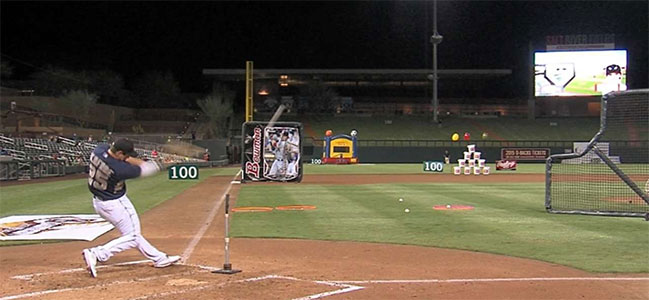
If you are a part of baseball, then you might know that of the first things a hitter will do when they get to the cage is grab the tee or start hitting front-toss. These are great drills to warm-up, because you can take your time loosing up the swing before taking real hacks. This has been a staple for many years, but I believe that it could be making players worse at hitting. There are two main reasons I believe this; timing and rhythm are not trained, and the understanding of ball flight is not taught. I have seen this with most of the players that I have worked with since I started coaching in 2016. Amateur hitters have become much better at performing practice than in a game. One way that I convey this is having the hitters think about how many swings they take in the cage, rather than on the field. Going over these two factors will give several reasons why blocked training needs to happen on-field more often. The cage has been a great tool ever since Branch Rickey started using it with Dodgers back in the day. Branch is known for the signing of Jackie Robinson, but was also a great innovator for the game of baseball. I’ve attached a quick little article explaining what he meant to the game of baseball. When Branch started using the cage, he used it for a solution to time constraint. In today’s game of baseball this is also true…but not always the case.
Rhythm and timing are a huge factor in the success of hitting and often go under trained at the amateur level. The mindset between the cage and on-field is very different. When in the cage, a player is usually thinking about swing mechanics and while on-field they are thinking about getting a “hit”. While taking regular batting practice, I see the majority of great hitters “flowing” while amateurs swing hard. It is my belief that the cage swings off of the tee and under-hand front-toss are what cause this disconnection. Many traditions in baseball stay around for a long time because of the phrase, “that’s the way we do it” or “look at what the professionals do.” Over the past few years these phrases have become way less accepted. This transition started around the time when I started coaching, so I have been fortunate enough to have an open mindset from day 1 of my coaching career. With this open-minded thought process I started thinking, “How often do I see players hit off a tee on the field or hit front toss on the field?” The answer to this question is NOT often. If a form of practice is good enough to perform in a cage environment, should it be good enough to perform on the field? It is my opinion that they should be done on the field much more regularly. Depending on how much you perform each activity, there should be a rotation of what is performed for on-field practice. An example of this would be as such:
-Live coach pitch 30%
-Machine work- 30%
-Over-hand front-toss 20%
-Under-hand front-toss 10%
-Tee work 10%
These numbers are just for an example and not a representation of what I think practice should always look like. Using these numbers, we can now create a two-week template for a 5-day a week training cycle. It would be as simple as 3 days of live BP, 3 days of machine, 2 days of over-hand front-toss and one day of under-hand front-toss/tee work. I believe this rotation of on-field hitting practice would allow for better blocked-practice while in the cage. I have seen many players have a complete disconnection of what a good swing is in the cage and then on the field. Having all forms of your practice on-field should help your players understand the importance of rhythm and timing. Once young players understand that you don’t have to swing with 100% of your bat speed to hit the ball farther, the lightbulb then goes off. This lightbulb allows for them to start having trust in their sub-maximal swings, creating the “flow”.
The disconnection between the cage and field also has to do with ball flight. Machines like Rapsodo (linked below) have helped us understand what a good batted baseball looks like in the cage. Not every team is lucky enough to have access to this technology yet so players must guess where the ball would end up. This can cause disconnection because of having too much backspin on a baseball. The worst culprit for this is under-hand front-toss. The ball is coming in more like slow pitch softball than it is than a pitch in baseball. Looking at slow-pitch softball swings, they succeed with a negative attack angle. In this drill we can succeed with a negative attack angle, but not in a game. Taking this drill to the field helps dramatically because when a player takes a negative attack angle and crushes a baseball, they see how it hangs up in the outfield. If this were in a cage the majority would think this is a great swing and it will translate into a game. The same goes for a tee on the field because you could be hitting a baseball exactly where you want it but with the added distance, the ball hangs up. Another reason ball-flight gets misunderstood in a cage is because batted balls in the air do not look as aesthetically pleasing as a line drive up the middle. The stats show that we should be trying to hit for extra base hits and no singles, so why are we always aiming for the back of the cage? This topic of ball flight has been discussed at length over the past few years so I will not stay on the subject.
These are the benefits that I can see from taking blocked practice out onto the field for working on the swing. The benefits do not end with the swing. In these the blocked forms of training the success rate is much higher and the likelihood of a ball going out of play is far less. This can lead to many more defensive reps and baserunning reps. We are always looking to make practice more game-like and this is a great opportunity for your outfielders and baserunners to get more live reads rather than just fungos. As discussed earlier, the cage was made for time constraints, we can now save time by hitting and doing team defense at the same time. This is not saying the cage doesn’t have a place in baseball, this is just stating that we need to bring all forms of training for hitting out onto the field.
https://bleacherreport.com/articles/366949-branch-rickey-baseballs-chief-innovator
 CONNECTING THE DOTS BASEBALL
Leave a comment